A licensed gas technician from Chimney Sweep Abbotsford handles every gas fireplace repair on these inserts and zero-clearance fireplaces, and the order of work is fixed by the burner design. We look at the embers before the valve, the valve before the vent, and the vent before any part is ordered, because that sequence finds the fault fastest on this maker's units.
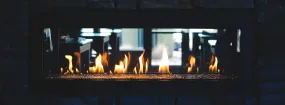
The EmberGlo burner under these units blends gas and air below the ember bed rather than at a row of exposed ports, which is how the flame gets its slow, wandering look. The ember material is therefore part of the air mixing, and a handful of embers brushed into the wrong place during a cleaning changes the flame as surely as a valve fault would. Our first act on a flame complaint is to lift the logs and lay the ember bed back to the factory pattern, then run the fire again before any gas reading is taken.
Control is the other brand-specific layer. Many of these units carry the optional Proflame remote system, which talks to a receiver wired at the valve and sets flame height, and some models add the HeatFlo air system that moves warmed air away from the firebox. A unit that has lost its remote, dropped to low flame, or shut itself down may have a receiver, a valve, or a safety sensor at fault. We test them in that order rather than replacing the costliest part first.
Enviro Gas Fireplace Repair Abbotsford usually begins with one of five complaints, and each one has a short list of causes that fits this burner and control design.
Pilot flame small and yellow - a pilot orifice narrowed by dust or a web after months idle, which starves the thermopile and leads to drop-outs once the firebox warms.
Burner lights across the bed slowly - ember material packed over the crossover path, so flame has to creep from one end rather than catching at once.
Fire stuck on low and will not step up - a Proflame receiver holding the low-flame command, flat receiver batteries, or a valve sticking between settings.
Insert shuts off after twenty minutes - the gas safety shut-off tripping on heat because the convection path or louvers are blocked, or a thermopile that reads fine cold and fails hot.
Gas odour at the louver with the fire off - a weeping pilot tube fitting or valve; turn the shut-off valve closed, leave the room, and call before using it again.
Gas-train parts for these units are specific to the fuel as well as the model, because each one runs on either natural gas or propane. The pilot assembly, orifice, and regulator setting differ between the two. A conversion kit exists for the changeover, and fitting one is a licensed gas job that ends with a pressure check, never a swap of the orifice alone. The receiver and handset for the Proflame system are matched to the generation of the valve, so an older insert cannot always take the current remote without a valve change as well.
Before you book, find the rating plate inside the louver cavity and photograph the fuel type and model, then photograph the pilot assembly with the fire off. Those two images let us bring the correct pilot assembly and thermopile on the first trip instead of the second, and they settle whether your unit has the remote system or a plain wall switch.
Ice on the liner cap and snow drifted against a wall termination are the two seasonal faults that stop these units in the coldest weeks of the year around Abbotsford. An insert fitted into a masonry fireplace vents through two flexible liners, one for exhaust and one for combustion air, which run side by side up the old chimney to a cap at the top. A cap crushed by ice, a liner kinked at the damper frame, or an air liner that has slipped off the insert collar each push the flame off its pattern and can trip the safety shut-off. A zero-clearance fireplace such as the DV42 or DV50 DX vents through a sealed coaxial pipe to a wall or roof termination instead, and a snowbank against that cap does the same job as the ice.
The other seasonal pattern is the first light after a summer off, when a pilot that ran clean in spring burns weak because the orifice has collected dust. Whatever the season, the glass gasket on the firebox is what keeps combustion gases on the vent side of the glass, and we renew it whenever the glass has been off. Keep a carbon monoxide alarm within earshot of the room, and treat an alarm, a headache, or soot appearing on the logs as a reason to switch the unit off and call. A direct-vent unit whose liner cap stays clear and whose gasket is renewed when disturbed keeps its burner and valve in service for many winters.
Our order of work is the ember bed reset and a test burn, a pilot and thermopile reading, a leak and pressure check, and the vent inspection last, with parts quoted from the rating plate afterwards. The technicians Chimney Sweep Abbotsford sends hold a gas licence and are insured for the work, and most repairs on this burner design are finished in a single visit.
Dial (778) 909-5649 to book, or send the two photos described above when you contact us through the site. Either way, Enviro Gas Fireplace Repair Abbotsford is scheduled with the correct pilot assembly already loaded for the trip.

Keep your home safe and your chimney spotless in Abbotsford. Our professional chimney cleaning team removes buildup so your fireplace works as it should.

Experience the difference a thorough chimney sweep can make in Abbotsford. We clear soot, blockages, and hazards so your home stays warm and secure.

Comprehensive chimney sweep services are just a call away in Abbotsford. From creosote removal to smoke draft solutions, we’ve got your chimney covered.

Need reliable fireplace solutions in Abbotsford? Our fireplace experts handle everything from inspections to complete restorations with precision.

Restore the clean, cozy feel of your fireplace in Abbotsford. Our gas fireplace cleaning removes buildup and leaves your unit running smoothly.

Stay warm all season long with expert gas fireplace maintenance in Abbotsford. We inspect and service all key components to prevent issues before they start.